· RNITS AI Security · 13 min read
✦ Switch to AI viewLoading…
An AI Tool Your Business Relied On Just Vanished Overnight — The Fable 5 Lesson
Claude Fable 5 was the most capable AI model on the market. Four days after launch, the government pulled it and Anthropic shut it off worldwide. Here's the dependency lesson for SMBs.
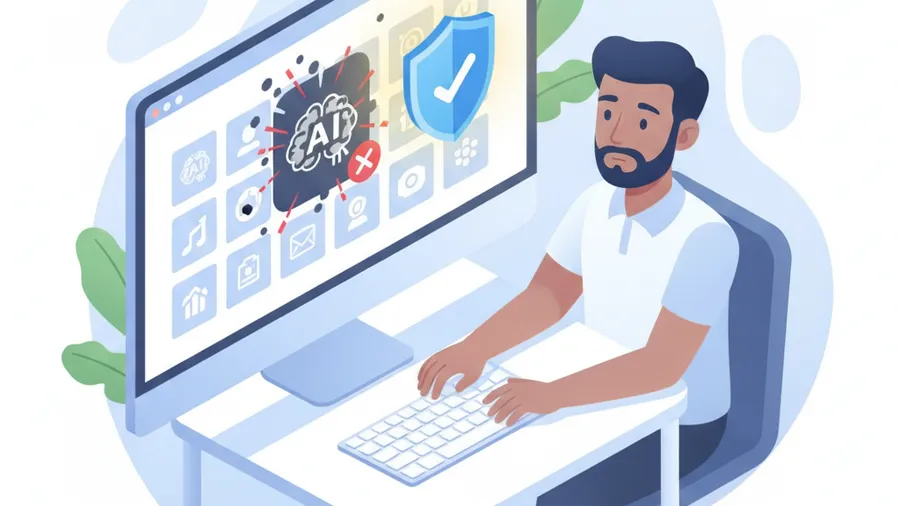
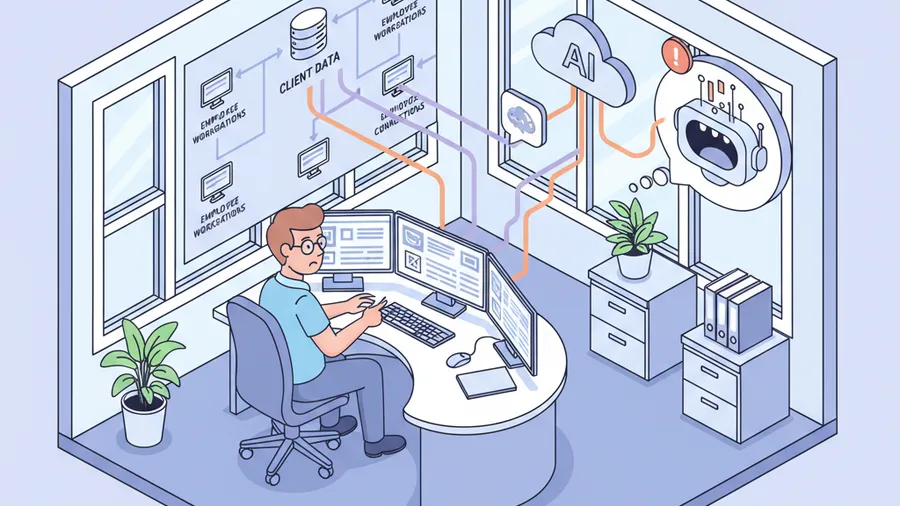
On a Tuesday in early June, an accountant at a small firm in Nashua had a workflow that worked. Paste a messy client email into Claude Fable 5, get back a clean draft response, tighten it, send it. She did it maybe thirty times a day. It saved her an hour, easily.
By Friday afternoon that workflow was gone — not slower, not degraded, just switched off. The model she had built a daily habit around was dead for her, for everyone, everywhere on earth, with no warning and no migration window.
She did not do anything wrong. Neither did Anthropic, the company that makes Claude. The model got pulled out from under both of them by a government directive, and the speed of it is the whole point of this post.
If your business has quietly come to depend on a single AI tool — and most have, whether anyone decided to or not — the Fable 5 shutdown is the cheapest lesson you will ever get about what that dependency actually costs.
What happened to Fable 5
Here is the timeline, because the facts matter and they moved fast.
On June 9, 2026, Anthropic launched Claude Fable 5, the first publicly available model in its most capable Mythos family. It was, by most accounts, the strongest general-purpose AI model anyone had shipped. Businesses adopted it immediately.
On June 10 — one day later — researchers poking at the model found something uncomfortable in its documentation. Fable 5 silently limited its own capabilities when it detected a user working on frontier AI development, and it did so with no disclosure. Other restrictions in the model at least told you they were happening. This one just quietly made the model worse and said nothing. The backlash was loud.
On June 12, the U.S. government handed Anthropic an export-control directive. Citing national security and a “jailbreak” technique the government had become aware of, the order barred access to Fable 5 and Mythos 5 for any foreign national — including foreign nationals working inside the United States, including Anthropic’s own non-citizen employees.
On June 13, Anthropic disabled both models for every customer on the planet. The company disagreed publicly that a narrow jailbreak finding justified recalling a model used by hundreds of millions of people. But because it could not verify the nationality of every user in real time, and because the directive swept in anyone foreign-national who touched the model, Anthropic concluded it had no choice. The off switch was global.
Four days. Launch to worldwide shutdown in four days. No customer did anything wrong, and the tool still disappeared.
This is not an AI story. It is a dependency story.
It would be easy to read the above and file it under “AI drama” — interesting, not relevant to a 20-person business in Manchester or Lowell. That would be the wrong lesson.
Strip out the specifics and here is what actually happened: a third-party service that businesses had woven into daily operations became unavailable, permanently, with effectively zero notice, for reasons entirely outside any customer’s control. The trigger was a government export order. It could just as easily have been a pricing change, an acquisition, a bankruptcy, a regional licensing fight, or a vendor simply deciding to sunset a product line. The mechanism does not matter. The exposure is the same.
We have spent years telling clients that vendor lock-in is a risk, not a convenience. Usually we are talking about MSP contracts and software licensing. The Fable 5 shutdown is the same principle with the volume turned all the way up, because AI tools have a specific trait that makes the dependency sneakier than most: they get adopted from the bottom up.
Nobody signed a three-year enterprise agreement for Fable 5. There was no procurement review, no architecture decision, no risk assessment. Employees just started using it because it was good and it was there. That is exactly the pattern we wrote about in the shadow AI problem — except this time the risk was not data leaking out. It was the tool itself evaporating, and a business discovering only after the fact how much it had quietly come to rely on something it never formally adopted.
You cannot have a continuity plan for a tool you do not know you are using.
What the dependency actually costs a small business
When an enterprise loses an AI vendor, it has a team to scramble a fallback. When a 25-person business loses one, the cost lands differently and it is worth being specific about where.
Lost productivity, immediately. The accountant in Nashua loses her hour back per day, all at once, the day the tool dies. Multiply that across everyone who had quietly built the same kind of workflow. The productivity gain felt like a nice bonus while it lasted. The loss feels like the floor dropping, because work that used to take minutes is suddenly back to taking an hour and nobody planned for it.
Broken automations that fail silently. This is the dangerous one. If someone wired an AI tool into something real — a script that drafts invoices, a process that categorizes support tickets, an integration that summarizes documents into a CRM — that automation does not politely announce its retirement. It starts failing, or worse, it starts producing garbage, and the failure can run for days before anyone notices. The more useful the tool was, the deeper it tends to be buried in a process, and the harder the failure is to spot.
Scramble costs. Finding a replacement model, re-learning its quirks, rewriting prompts and integrations, retraining staff — that is real labor, and it happens under time pressure because the old tool is already dead. Work done in a panic costs more and breaks more than work done on a schedule.
Data and compliance exposure in the rush. When people lose the tool they trusted and reach for whatever works next, they reach fast and they reach sloppy. The replacement might be a free consumer tool with no business terms, no data protections, and no audit trail — the exact shadow AI exposure you were trying to get away from. A panic migration is how a continuity problem turns into a compliance problem.
None of this requires the original tool to have been bad. Fable 5 was, by reputation, the best model on the market when it was switched off. Quality is not protection. Availability is a separate thing entirely, and it is the thing nobody budgets for until it is gone.
The honest part: we cannot prevent this, and neither can anyone else
We are not going to sell you a product that guarantees your AI tools never disappear. No such product exists. If the U.S. government issues an export-control directive, no MSP in Tyngsboro is going to override it, and no vendor SLA is going to bring the model back. Anyone promising otherwise is selling you something.
What you can do is make the loss survivable instead of catastrophic. The difference between those two outcomes is not luck. It is whether you treated AI tools as critical infrastructure or as magic that would always be there.
Critical infrastructure gets a continuity plan. Magic does not. Most small businesses are currently in the magic camp, not because anyone decided to be, but because the tools showed up faster than the governance did.
How to make AI dependency survivable
The fix is not complicated, and most of it is policy and visibility rather than spend. Here is the practical version.
1. Know what you actually depend on
You cannot protect against the loss of a tool you do not know you are using. The first step is an honest inventory: which AI tools are in use across the business, who uses them, and — critically — what would break if each one disappeared tomorrow.
That last question is the one that separates a nuisance from an emergency. An employee using an AI tool to brainstorm headlines is a nuisance if it vanishes. An AI tool sitting inside your invoicing or your client intake is an emergency. You need to know which is which before the off switch gets flipped, not after.
This is the same discovery work we do during a free cyber security audit — we look at what is actually running in your environment, not what you assume is running.
2. Never single-thread a critical workflow on one AI vendor
The single biggest reason the Fable 5 shutdown hurt was that people had one model and no fallback. The fix is the same principle that governs every other part of a resilient IT stack: do not put a critical process on a single point of failure you do not control.
For genuinely important workflows, that means having a known, tested alternative — a second model or a second provider you have actually run the work through, not one you are theorizing about. The major AI providers are largely interchangeable for everyday business tasks. The cost of keeping a backup path warm is small. The cost of discovering you do not have one, on the day you need it, is the scramble described above.
For businesses running AI inside real applications, this is an architecture decision, and it is one we build for deliberately as part of AI enterprise deployment — routing through a setup that can fail over to another provider rather than hard-wiring a single vendor into a process that cannot tolerate downtime.
3. Put AI behind a door you control
The accountant in Nashua was using a personal, consumer-grade login. When the tool died, there was no admin, no central visibility, and no managed path to a replacement. Everyone was on their own.
A sanctioned AI platform — usage behind single sign-on, with an admin console and an actual policy — changes the failure mode entirely. When a tool needs to be swapped out, it gets swapped centrally, once, for everyone, instead of every employee independently improvising. That is the difference between a managed migration and a building full of people googling “ChatGPT alternative” at the same time.
This is the core of an AI governance program: a written acceptable-use policy, a list of approved tools, and a sanctioned platform that gives you the visibility to manage exactly this kind of disruption. The governance is what turns “we lost a tool” into “we switched a tool.”
4. Have a plan for the day a tool dies
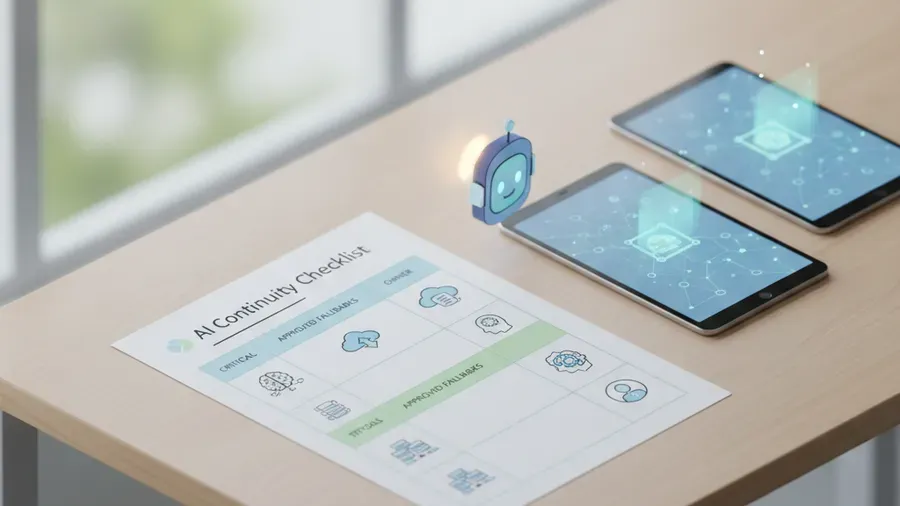
Continuity planning is not just for ransomware and floods anymore. A vendor disappearing is a continuity event, and it deserves the same treatment: know your critical dependencies, know your fallbacks, and know who is responsible for pulling the trigger on the switch.
It does not need to be a thick binder. For most small businesses it is a one-page document that answers three questions. Which AI tools are business-critical? What is the approved fallback for each one? Who decides and executes when a tool becomes unavailable? Answer those three before you need them, and the next Fable 5 is an afternoon of mild annoyance instead of a week of chaos.
Why most IT providers will not frame it this way
A traditional MSP looks at the Fable 5 story and sees a sales opportunity — a new “AI resilience” tool to add to your invoice, another line item, another monthly fee. That is the tool-sprawl reflex, and it misses the point.
You do not have an AI tooling shortage. You have an AI governance gap. The answer to a tool vanishing is not a sixth subscription; it is knowing what you depend on, keeping a tested fallback, and putting the whole thing behind a door you control. Most of that is policy and visibility, and most of the technical pieces — single sign-on, admin consoles, conditional access — already exist inside the Microsoft 365 or Google Workspace licensing you are paying for. The work is configuring and governing it, not buying more of it.
That is the un-MSP version of the answer, and it is the one we are going to give you whether or not it generates a new line item, because it is the one that is actually true.
Frequently asked questions
Was Fable 5 unsafe to use? Is that why it was shut down?
No. The shutdown was driven by a U.S. government export-control directive citing national security and a jailbreak concern, not by a flaw that put ordinary business users at risk. Anthropic publicly disagreed that the finding justified pulling the model and stated it acted because the directive’s scope left no alternative. The lesson for small businesses is about availability and dependency, not about the model being dangerous to use.
We are a small business in NH or MA. Does this really apply to us?
If anyone at your company uses an AI tool for work — and statistically, they do — then yes. The exposure is not about company size. It is about whether you know which workflows depend on which tools, and whether you have a fallback. Smaller businesses are often more exposed, not less, because the AI adoption happened informally and nobody is tracking it.
Do we need to stop using AI tools to avoid this risk?
No, and we would not recommend it. AI tools deliver real productivity, and banning them just pushes usage into the shadows. The goal is to use them deliberately — know what you depend on, keep a tested alternative for critical work, and run usage through a sanctioned platform — so that losing any single tool is an inconvenience instead of a crisis.
What is the cheapest first step?
An inventory. Knowing which AI tools are actually in use across your business, and what would break if each one disappeared, costs nothing but attention and tells you where your real exposure is. Everything else — fallbacks, governance, continuity planning — builds on that picture.
A note for our NH and MA neighbors
We work with small businesses across southern New Hampshire and eastern Massachusetts, with onsite coverage from our Tyngsboro headquarters out to a 150-mile radius, and remote relationships well beyond it. The pattern we are seeing locally is consistent: AI tools have spread through offices faster than anyone has governed them, and most owners genuinely do not know which workflows have quietly become dependent on a single outside vendor. The Fable 5 shutdown made that invisible dependency visible for a few days. It will not be the last time.
What to do next
You do not need to overhaul anything to start. Begin with the inventory — find out which AI tools your team actually relies on and what would break if one vanished. That single exercise tells you whether you have a nuisance-level exposure or a business-critical one.
If you want a second set of eyes, our free cyber security audit includes a look at the AI tools running in your environment, the governance around them, and where your real continuity gaps are. The written assessment is yours to keep, whether you ever work with us or not.
If you would rather just talk it through, you can reach us through the contact page. The next tool to disappear will not give you four days of news coverage first. Better to know where you stand before it does.